
Community events are a massive part of running our non-profit. They get the word out for our cause and put us right out into the very community we are trying to support. People often ask me how Thaar Care distinguishes itself from others. For us, it comes down to accessibility: we see children and young adults, adults and seniors, we accept most insurances, and our foundations and grants directly assist our children with financial support for their therapy.
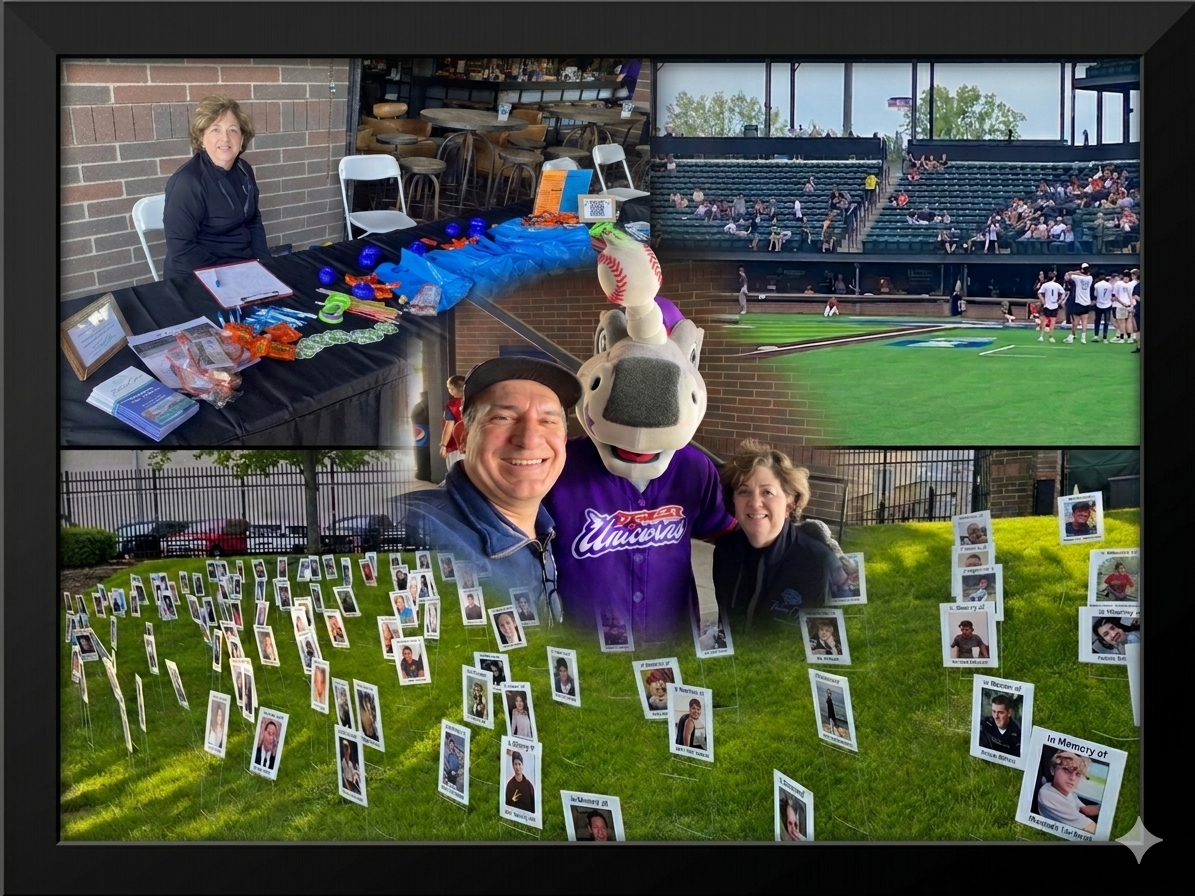
To support Mental Health Awareness Month, UWM hosted a Mental Health Night for opening day baseball. We were out there alongside Shawn Davis and the Brendan Davis Memorial Foundation, a beautiful organization created to honor Brendan’s memory by turning an unimaginable tragedy into a life-saving mission for others. They were collaborating with the “Be Nice” Mental Health Foundation, a program dedicated to promoting mental health awareness and suicide prevention in schools in our area.
The event featured a memorial hill that represented those who were being honored Those honored have all passed from suicide. Because we are currently in the midst of Men’s Mental Health Awareness Month, I was deeply saddened to look at that hill and see just how many pictures of young male adults were part of it.
Looking at that hill brought me straight back to a snowy day in January of 1995. I was getting ready to celebrate my son’s second birthday and I was five months pregnant. I will never forget the phone call we received at 7:00 AM that cold morning, letting us know that our beloved brother-in-law had taken his life at 28 years young. The shock and pain are always right there beneath the surface whenever I hear of another loss. It is gut-wrenching, another family suddenly stuck in a group that no one ever wants to be a part of.
But can good come from sadness. There are so many wonderful non-profits out there raising funds and doing the heavy lifting to prevent suicide, and we are proud to be right there with them. At the recent event, we brought a portion of the more than 1000 gun locks we’ve been provided for free by local police, sheriffs, and national programs to pass out to the community. These simple tools are incredibly powerful in fact, distributing gun locks has helped cut the daily rate of predominantly male veteran suicide rates in half.
I sometimes wonder: How can we measure if our youth are actually getting the message on mental health and suicide prevention?
Well, almost every single young person who visited our vendor table asked about those gun locks. They were drawn to the shiny, red metal wrapped in plastic, each with a little key. That key represents everything. It represents those critical, five-second choices between life and death.
Once we explained exactly what they were for, their immediate reaction was to turn to their parents and ask, “Dad, Mom, do we need this?”
My heart absolutely melted, and I was covered in goosebumps. These young adults recognized the importance of safety immediately. They even started pulling over their friends who own hunting guns, telling them to grab a few locks for their guns at home.
Talk about a true feel-good moment that has a real, tangible impact.
Sometimes I worry that our work isn’t reaching people or assisting them the way we hope. Days like this confirm to me that we are making a genuine difference.
If you or someone you know is in need of assistance, please contact us. Your donations directly and 100% cover therapy expenses for clients in need of mental health support. Together, we all make a difference.
The Statistic and Men’s Mental Health:
- The Gender Divide: Men account for approximately 80% of all suicide deaths in the United States, meaning 4 out of 5 people who take their own lives are male.
- The Ratio: The male suicide rate is consistently 4 times higher than the female rate. According to the American Foundation for Suicide Prevention (AFSP), the male suicide rate sits at roughly 22.2 deaths per 100,000 people, compared to 5.6 per 100,000 for women.
- Age Risk Factors: While suicide is the second leading cause of death for young men (ages 15–34), the highest overall rate belongs to older men, specifically those aged 75 and older.
- The “Silent” Factor: A major study by the CDC and UCLA revealed that 60% of men who died by suicide had no documented or known history of mental health conditions. This strongly suggests that many men experience intense personal crises or underlying depression that goes completely unnoticed or unrecorded before it reaches a breaking point.
- The Treatment Gap: Nearly 1 in 10 men report experiencing daily feelings of depression or anxiety, yet less than half seek professional help. NIMH data shows that only about 41% to 45% of men with a recognized mental illness receive treatment in a given year, compared to nearly 57% of women. Nationwide, over 6 million men suffer from clinical depression every year, and over 3 million struggle with panic disorders, OCD, or phobias.
Our Vision for the Future
This vital work is only possible because of you, our donors, our community, and our partners. Your unwavering generosity is what allows us to keep saying “yes” to those in need.
As I look ahead, I think about our children. They are our future. We continue to work toward a day where going to therapy is as natural and destigmatized as going to the doctor or the dentist.
Where suicide rates decrease yearly instead of increase.
Thank you for being part of the Thaar Care story. Together, we are ensuring that no one in our community ever has to choose between their financial security and their mental well-being.